
Your Custom Text Here
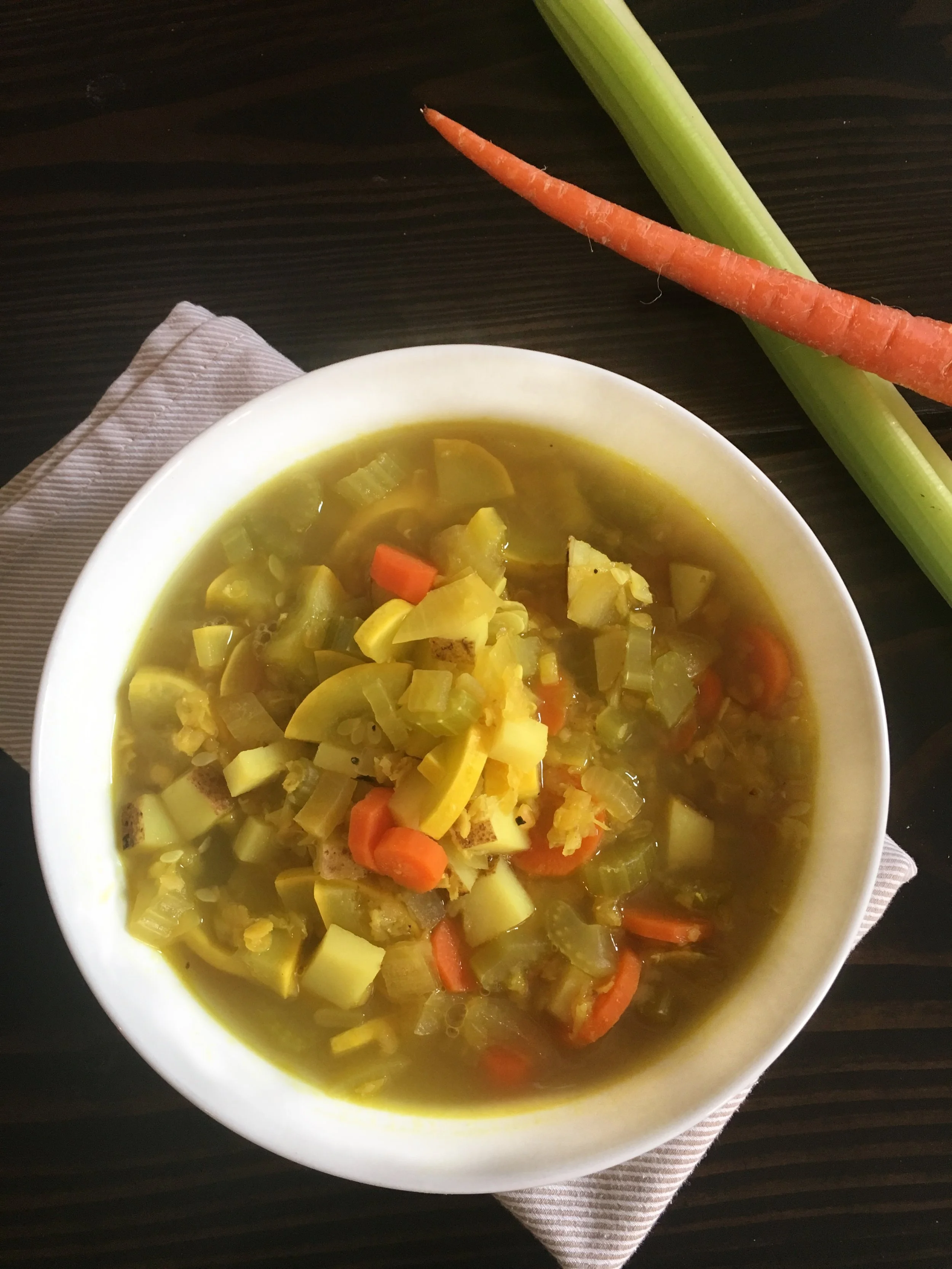
Vegetable Lentil Soup
This soup will warm your belly and your soul!
Vegetable Lentil Soup
Soup is by far one of my favorite dishes to make. It is simple and delicious. You can easily substitute with vegetables that you have on hand.
Dosha Considerations -
Good for vata - can sub mung beans or red lentils for regular lentils.
Pitta can skip onion and reduce or skip ginger. Pitta can also sub garbanzo beans for lentils.
Kapha types can add dash of cayenne and reduce ghee. Remove potatoes.
INGREDIENTS
- 2 tbsps ghee
- 1 onion, diced
- 1 inch ginger, grated
- 1/2 tsp cumin
- 1/2 tsp turmeric
- 1 tsp salt
- Pepper to taste
- 2 carrots, peeled and diced
- 3 stalks celery, diced
- 2 potatoes, diced
- 1 zucchini squash, diced
- 6 cups purified water
- 1/2 c lentils
DIRECTIONS
- Using a large pot, place on stove on medium low heat. Add ghee and melt. Add onions and let simmer for a few minutes.
- Add in ginger, cumin, turmeric, salt and pepper. Let simmer for a few more minutes.
- Add in carrots, celery, potatoes and squash. Stir to coat ghee, spices and vegetables.
- Pour in water and lentils.
- Turn heat to medium until boiling then turn down to low. Simmer soup for 45 minutes. Salt and pepper to taste.
- Enjoy!
Note: You can also make rice, and a scoop before ladling soup into bowls for a more filling meal.
Authenticity in 2018
As you set intentions about what you would like to manifest in 2018 connect with your authentic self. Move ego to the side and get clear about what you really desire!

Setting Intentions
As the New Year settles in, I, like many, am setting intentions for the year ahead. This year I seem to have difficulty reigning my thoughts in. As life's responsibilities increase, focus becomes more delicate yet more important. To help gain clarity, I used a process for life reflection and goal setting which I had been shown a few years ago. It forced me to stop and think critically about where I am on my life journey and where I desire to place my attention and intention in 2018. I focused on areas that bring meaning to my life experience as I know it: personal well-being, relationships, career, community engagement and leadership.
The overarching word that came up for me during this introspective process was authenticity.
Authenticity
As a collective, being true to our most authentic self is not always the easiest route to take. Our friends, family, community, society, social media, television and ad campaigns send us conscious and subliminal messages about who we should be and/or how we should live.
My invitation is that you connect with your true self. Show up, listen, and let your focus be on what YOU (the deepest and maybe scariest depths of you) truly desire to cultivate this year. This honest process begins by being authentic with yourself.
Let us define authenticity as to uncover the meaning and relationship of the word to you. Authenticity is the act of being authentic. According to Merriam-Webster, authentic is "not false or an imitation". It is being "true to one's own personality, spirit, or character".
The bigger questions: What does authentic mean to you? What does authenticity look and feel like for you? How do you show up in your life with your unique spirit?
When thinking about resolutions, intentions, goals, etc. for the new year: Do you set them because you want to accomplish X,Y,Z? Or do you set them because you think you should accomplish X,Y,Z?
It's subtle, but different. Understanding this distinction helps you clearly see the way you look at yourself and how you maintain a relationship with your authentic self. Are you showing up to your life in the way that your higher self knows you should? The authentic you is not concerned with your ego or the ego of others. That same you is not preoccupied with what others think about you or how you should exist.
I believe the higher self is deeply intelligent and connected to all beings and existence. The higher self understands that all obstacles you face are an invitation to grow in ways that your unique soul needs to evolve in this lifetime. It is intuitive and knows what's right, but you have to listen.
How do you get connected to your higher self?
The path we take to get there looks different for all of us, but I believe that the feeling of connection to our higher self is similar for everyone. For me, the path to my higher self looks a few different ways: My yoga practice is where I get real and clear with myself; Meditation and reflection is valuable to uncover and accept my deeper desires; Hardships and tough times expose me to where I feel most vulnerable; The outdoors connect me to spirit.
When do you feel most authentic, real and raw? What do you do to become clear about a messy situation or decompress after a difficult conversation? These inquires will help you connect to your highest self.
The actions we take day in and day out bring us closer to connection or disconnection with our true self. I invite you to keep taking the actions that lead you closer to YOU. Only you know when you are being truly authentic and when you are not.
The Invitation
Now, invite yourself to cultivate intentions, resolutions and goals for 2018 that serve your true self. If you already have intentions, then reevaluate. Do they really feel authentic? Write them down, and share your intentions with passion and love. Authenticity is contagious. Let your walls down, and invite people to see who you really are. They can drop their armor. Let's help each other heal and build from the inside-out in 2018.
I see you and honor you. Namaste!
To get updates and learn about Shri Wellness offerings join our newsletter by signing up below.
Stuffed Kabocha Squash
Kabocha squash is a Japanese winter squash with robust flavor.

Stuffed Kabocha Squash
A kabocha squash is a Japanese pumpkin. They have a rich, delicious flavor and are similar to pumpkin and sweet potato. These squash are harvest in the fall, and therefore great for fall and winter!
According to The World's Healthiest Foods, winter squash boasts a slew of nutrients. Here are some notable nutrients: vitamin A 59%, vitamin C 26%, fiber 23%, vitamin B6 19%, manganese 19%, copper 19%, potassium 14%, vitamin B2 11%, pantothenic acid 10%, folate 10%, vitamin K 10%, omega-3 fats 8%, magnesium 7%, vitamin B3 6%.
Serving size: 2
Prep and cook time: 45 minutes
Dosha Considerations - Good for vata - be sure to cook kale well. Kapha - sub celery for squash and sub ghee for flax or sunflower oil. Pitta - you can reduce to 1/4 onion, sub rice for quinoa and sub ground coriander for rosemary.
INGREDIENTS
- 1 kabocha squash
- 1/2 onion, diced
- 1 cup zucchini, diced
- 4 leaves kale, finely chopped
- 1/2 cup quinoa
- 1 cup water
- 1 tablespoon ghee
- 2 teaspoons rosemary
- Salt and pepper, to taste
- Lemon wedges
DIRECTIONS
- Preheat the oven to 350 degrees.
- Cut kabocha squash in half and remove seeds. Put squash face down on baking sheet and place in oven. Cook until just about tender. Test for tenderness by inserting knife or fork into yellow squash close to the rind. It will insert easily when close to done, and takes about 30 minutes.
- Place quinoa and water into saucepan. Turn on medium high heat until boiling. Add top and cook for about 20 minutes.
- While squash is cooking, preheat large frying pan to medium heat. Add in ghee. Cook until melted.
- Add in onions and cook until soft. Add in zucchini, kale and rosemary. Salt and pepper to taste. Cook until soft then add in cooked quinoa.
- Remove squash from oven. Flip so the tops face up. Add in vegetable mixture. Place back in oven for about 5 - 10 minutes until vegetable mixture is just crisp on top.
- Remove from oven. Squeeze a little lemon juice over vegetable mixture and serve.
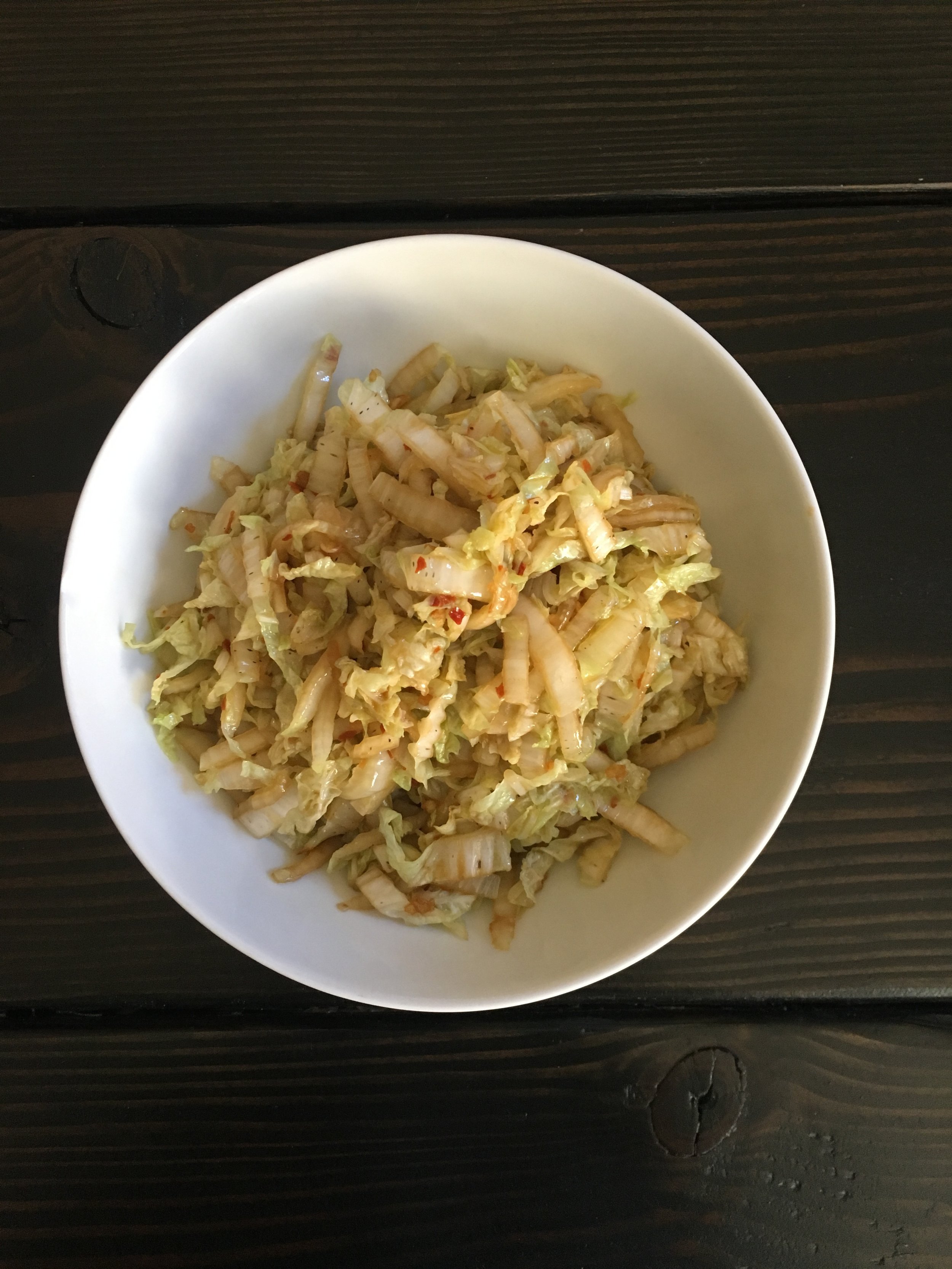
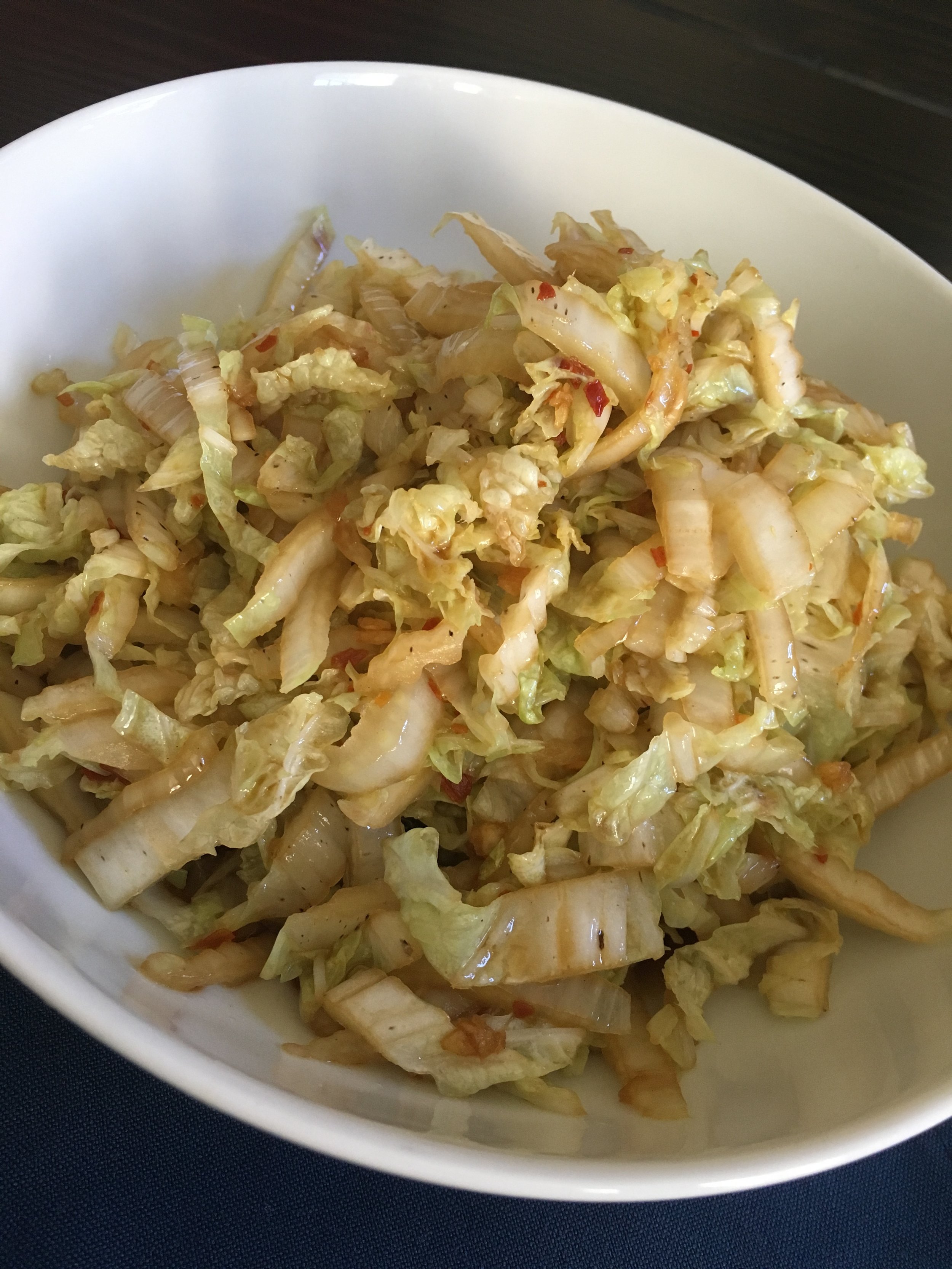
Asian Inspired Napa Cabbage
This asian inspired napa cabbage is delicious. It makes for a quick side or light supper.

Asian Inspired Napa Cabbage
Recipe adapted from Food & Wine.
Serving size: 2 - 4
Prep time: 10 minutes
Cook time: 6 minutes
Dosha Considerations - Good for vata and kapha. Reduce or avoid for pitta due to spices and garlic.
INGREDIENTS
- 3 cloves garlic, pressed
- Salt
- 2 tbsps soy sauce
- 2 tbsps sesame oil
- 1 tsp water
- 1 tsp red-pepper flakes
- 1/4 tsp raw turbinado sugar
- One head Napa cabbage, thinly sliced
- 2 teaspoons sesame seeds, toasted (optional)
DIRECTIONS
- Press garlic and add pinch of salt.
- Stir minced garlic, soy sauce, 1 tbsp sesame oil, water, hot red-pepper flakes and sugar together in a small bowl.
- Heat remaining sesame oil in a wok or large skillet over medium-high heat. Add cabbage and season with a pinch of salt. Cook until cabbage is wilted which takes about 4 - 5 minutes.
- Remove from heat and pour dressing over the cabbage. Toss to combine then place in serving dish. Garnish with toasted sesame seeds if you desire.

The Ayurvedic Clock
Ayurveda provides framework for how to best tune daily activities with the rhythm of nature. Read more about how to synchronize your schedule up with nature!

Ayurveda provides a framework for how to sync the mind and body up to the rhythm of nature. When we are in tune and in the flow with the cosmos then energy is steady, digestion is strong and the mind is clear. Life becomes easier because we are swimming with the current - not against it.

The Ayurvedic clock is broken down into six cycles. Three cycles occur during the day and three during the night.
Before laying out the clock, it is beneficial to understand the energies which guide us. Ayurveda is based on the five great elements: earth, water, fire, air and space. These elements combine to create three doshas. Dosha is a sanskrit word which provides understanding to the elements and relating qualities. The three doshas govern mental and physical response.
Vata is the lightest dosha comprised of air and space.
Pitta is the hottest dosha comprised of fire and a little water.
Kapha is the densest dosha comprised of earth and water.
Day Cycle
6a - 10a - Kapha Time
Dense kapha energy is strong at this time. It is best to engage in movement and exercise because there is already natural lubrication and strength in the physical body. Exercise also shakes any lethargy or heaviness in the mind.
10a - 2p - Pitta Time
The sun is at the highest point in the sky which increases the fire element. Use the hot, fire-like energy in your advantage and enjoy a large, slow lunch because the digestive fire is strongest this time of the day!
2p - 6p - Vata Time
Vata invokes light and mobile energy, so harness this energy through a focus on work. The subtle and expansive qualities offer greater creativity and productivity. It is also a time of transition from the day cycles to night cycles.
Night Cycle
6p - 10p - Kapha Time
Enjoy a light meal. Digestion is not as strong during this time of the day. Supper is supposed to be supplemental meaning it should supplement the mid-day meal. If unable to exercise in the morning, this is a good alternate time to exercise. Get into bed and aim to be asleep before 10p while the dense energy can ease you into a restful night's sleep.
10p - 2a - Pitta Time
During this time, the fire and transformative energy of pitta is used to detox the system. It is important to be asleep before 10p, or else you may catch a second wind of energy. Being awake during this time affects your liver's ability to clean house or clean and repair your body.
2a - 6a - Vata Time
Start your day bright and early! The air is naturally lighter which makes for an easier transition into your day. You may notice that you are groggy if you wake after 6a during the kapha time. However, it is important that you get sufficient rest or waking up before 6a will be challenging.
Conclusion
Have you noticed any of these energies in your daily life? It can be overwhelming to think about switching your routine up. Habits are hard to break! The invitation is to begin noticing how the energy of each dosha affects your mind and body at certain times of the day. Perhaps start by slowly retiring to bed a little bit earlier each week over a few weeks, or have a slightly larger lunch than dinner. It is encouraged to make small changes and adjust habits over time!